

- This event has passed.
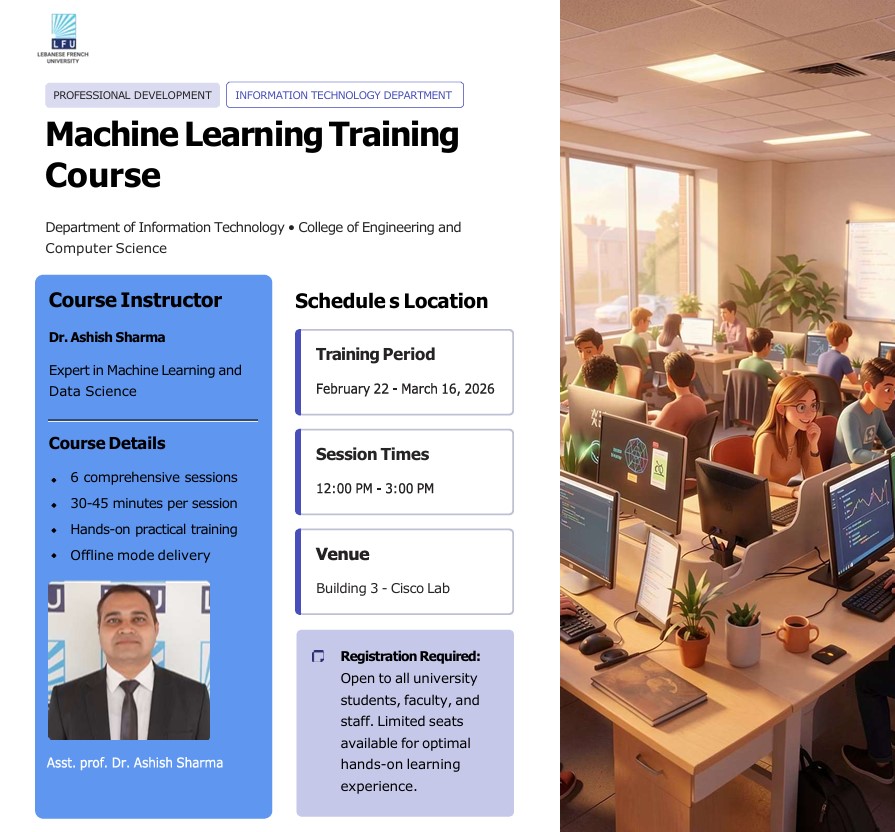
Training :- Machine Learning Using Python
February 22 @ 8:00 am – 5:00 pm
Proposal for Training on Machine Learning Using Python
Training Instructor: Dr. Ashish Sharma
Total Sessions: 06
Session Duration: 30 – 45 minutes each
Mode: Offline mode
- Introduction
Machine Learning (ML) has become a core component of modern technology, enabling systems
to learn from data and make intelligent decisions without explicit programming. From healthcare
and finance to education and engineering, ML applications are transforming industries and creating
new opportunities.
Python is the most widely used programming language for Machine Learning due to its simplicity,
readability, and powerful ecosystem of libraries such as NumPy, Pandas, Matplotlib, and Scikit
learn. This short-term training program is designed to introduce participants to the fundamentals
of Machine Learning using Python in a concise, structured, and practical manner.
Given the limited duration of each session (30 – 45 minutes), the training focuses on conceptual
clarity, essential algorithms, and hands-on exposure, ensuring that learners gain meaningful
understanding without being overwhelmed. - Objectives of the Training
The primary objectives of this training program are to:
- Introduce the basic concepts and terminology of Machine Learning
- Familiarize participants with Python as a tool for ML
- Explain different types of Machine Learning techniques
- Demonstrate simple ML workflows using real-world datasets
- Enable participants to understand how ML models are built, trained, and evaluated
- Build confidence to explore advanced ML topics independently after the training
- Expected Outcomes
After completing the six-session training, participants will be able to:
Implement simple Machine Learning models using Scikit-learn
Understand the fundamentals and importance of Machine Learning
Differentiate between supervised, unsupervised, and basic learning approaches
Use Python libraries for data handling and visualization
- Apply foundational ML knowledge to academic, research, or practical problem-solving
contexts
- Target Audience
This training is suitable for:
- Undergraduate and postgraduate students
- Research scholars
- Faculty members
- Professionals from technical and non-technical backgrounds
- Anyone with basic programming knowledge or interest in Machine Learning
Basic familiarity with Python is helpful but not mandatory.
- Training Structure and Session-wise Plan
Session 1: Introduction to Machine Learning
Content:
- What is Machine Learning?
- Difference between AI, ML, and Data Science
- Real-world applications of ML
- Types of Machine Learning (Supervised, Unsupervised, Reinforcement – overview)
Outcome:
Participants will gain a clear understanding of what Machine Learning is and where it is used.
Session 2: Python for Machine Learning
Content: - Why Python for Machine Learning?
- Overview of essential libraries: NumPy, Pandas, Matplotlib
- Working with datasets (loading and inspecting data)
- Basic data operations and visualization
Outcome:
Participants will be able to handle and explore datasets using Python.
Session 3: Data Preprocessing and Exploration
Content:
- Importance of data preprocessing
- Handling missing values
- Feature selection and scaling (conceptual overview)
- Exploratory Data Analysis (EDA)
Outcome:
Participants will understand how raw data is prepared for Machine Learning models.
Session 4: Supervised Learning – Regression
Content: - Concept of supervised learning
- Introduction to regression problems
- Linear Regression: concept and example
- Model training and prediction using Scikit-learn
Outcome:
Participants will be able to build a basic regression model using Python.
Session 5: Supervised Learning – Classification
Content: - Classification problems and use cases
- Common algorithms (Logistic Regression, KNN – conceptual overview)
- Simple classification example using Scikit-learn
- Model evaluation (accuracy, confusion matrix – basic idea)
Outcome:
Participants will understand how classification models work and how their performance is
measured. - Session 6: Unsupervised Learning and Conclusion
- Content:
- Introduction to unsupervised learning
- Clustering concepts (K-Means – overview)
- Simple clustering demonstration
- Summary of the complete ML workflow
- Career paths and next steps in Machine Learning
Outcome:
Participants will gain exposure to unsupervised learning and understand how to continue learning
ML. - Training Methodology
- Short conceptual explanations
- Live coding demonstrations
- Real-world examples and datasets
- Interactive discussions and Q&A
- Step-by-step explanation of ML workflows
- Conclusion
This six-session training program on Machine Learning using Python is designed to provide a
strong foundation within a limited time frame. By combining clear explanations with practical
demonstrations, the training ensures that participants not only understand the theory but also see
how Machine Learning is applied in practice. Under the guidance of Dr. Ashish Sharma,
participants will be well-prepared to explore advanced Machine Learning concepts and
applications in the future.
Proposed by:
Asst. Prof. (Dr.) Ashish Sharma,
College of Engineering & Computer Science,
Lebanese French University, Erbil, Kurdistan.
Training Instructor – Machine Learning using Python